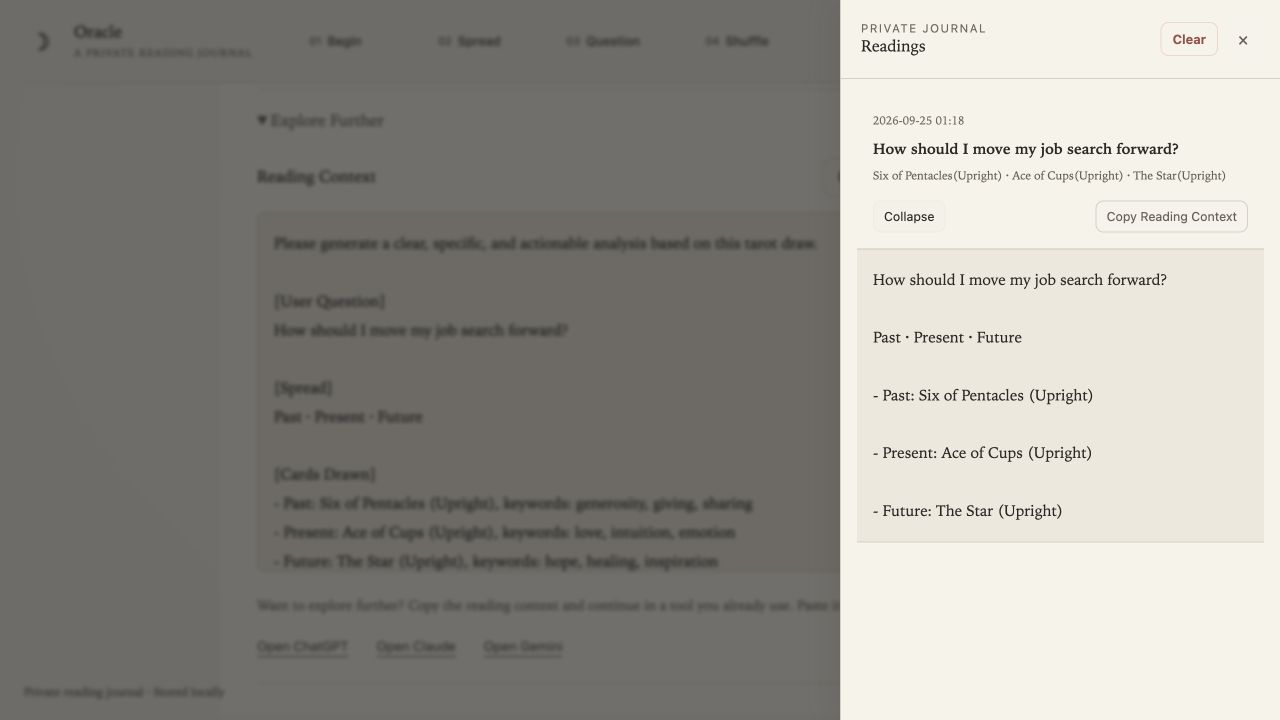
Decision 01
AI as an extension, not the product.
Early versions foregrounded prompts and external AI tools. The final design moves them one level deeper so the reading itself remains complete without AI.
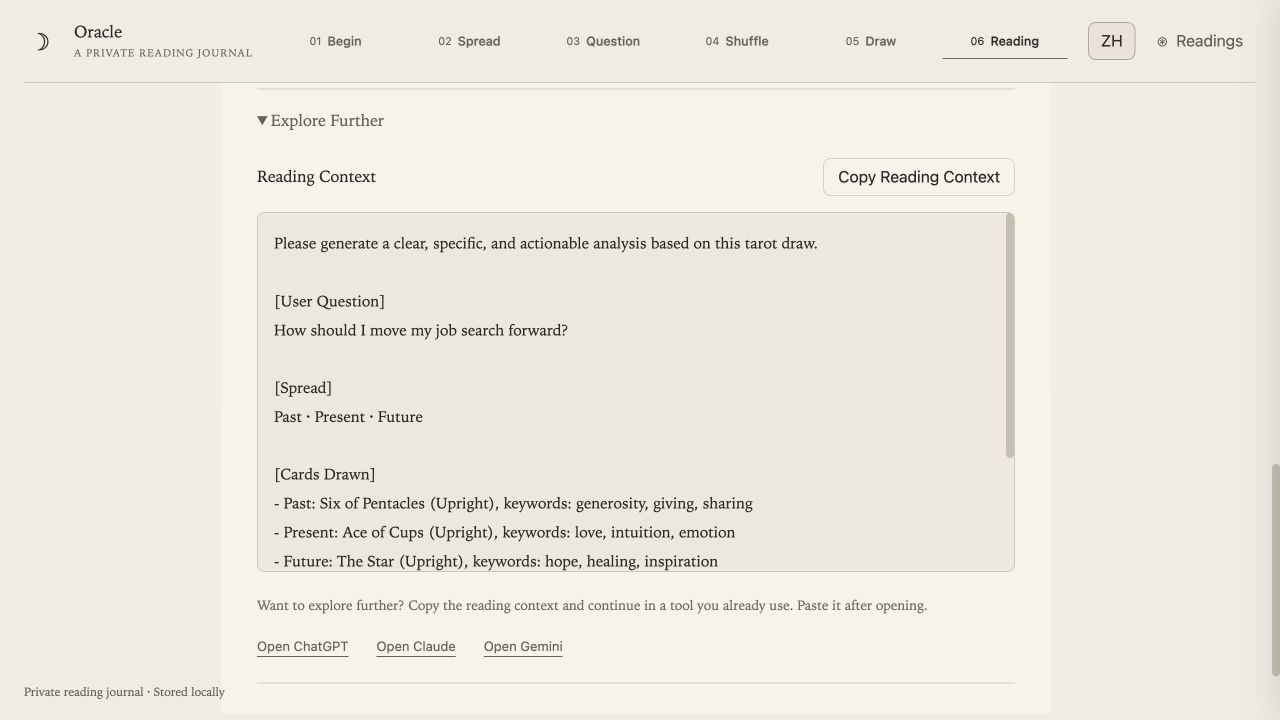
AI Product Prototype / A
Product Design / Interaction Design / UX / AI-assisted Prototyping
A personal product prototype exploring how a simple card-drawing concept could evolve into a complete reading journey through interaction design, visual iteration and AI-assisted development.
Designing a digital Tarot experience where interaction and reflection come before AI.
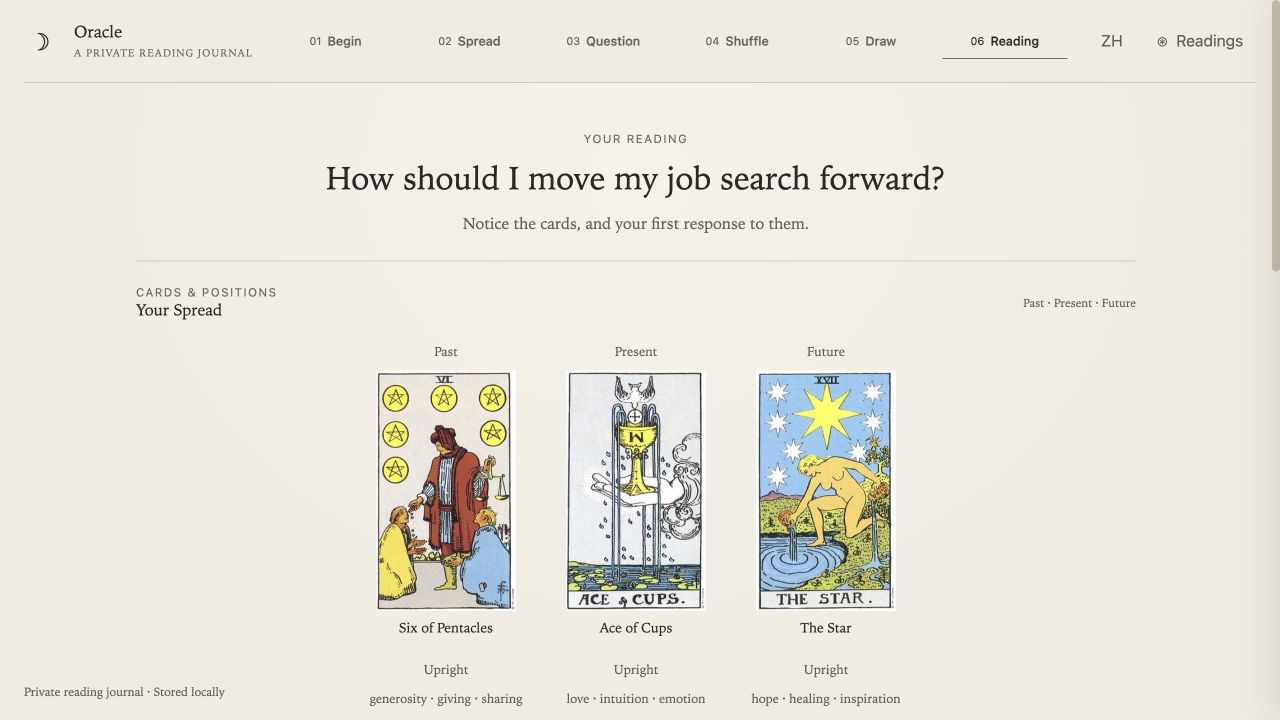
Oracle began as a simple Tarot card-drawing idea and gradually evolved into a complete reading experience.
The core product question became: How can a digital Tarot experience feel intentional and reflective rather than like a generic AI generator?
The experience was designed as a progressive journey rather than a single input-output interaction. Each step introduces only the information and action needed at that moment.
Reading journey
Conceptual journey. In the working prototype, spread selection precedes question entry.
Decision 01
Early versions foregrounded prompts and external AI tools. The final design moves them one level deeper so the reading itself remains complete without AI.
Decision 02
An interactive shuffle stage turns the transition before card drawing into a tactile moment of participation.
Decision 03
The visual direction moved away from dark purple, gold and glow toward warm ivory, paper-like surfaces and restrained editorial typography.
The final prototype supports 78 Tarot cards, 1 / 3 / 5-card spreads, interactive shuffle, upright / reversed states, a bilingual reading flow, local reading history and optional external AI continuation.
The project showed me that AI-assisted development makes implementation faster, but product quality still depends on defining the experience, evaluating the result and deciding what should be removed.